Poker Counting Odds And Outs
Pot odds are the ratio of the current size of the pot to the cost of a contemplated call.
For example, if there is $7,500 in a pot and villain bets $2,500. There is now $10,000 in the pot. It will cost you $2,500 to win a potential $10,000. If you make the bet the pot will be $12,500. You must win 1 out of 5 times or 20% to break even ($12,500/$2,500 = 20%)
Your pot odds are expressed as 1:4. In other words, you must win one pot and lose four pots to break even. If you win more than that, you will make money.
When the odds of drawing a card that wins the pot are higher than the pot odds, the call has a positive expectation. In other words, on average, you will win more money than what is costs to call the bet.
Conversely, if the odds of drawing a winning card are numerically lower than the pot odds, the call has a negative expectation. On average, you will win less money than what it costs to call the bet.
Implied Odds
Implied odds are our potential winnings by the end of the hand compared with the amount of money required to make a call. They are different than pot odds because they account for possible future betting.
Implied odds are calculated in situations where you have a draw. You expect to make money on additional bets if your draw is made. You can fold to a bet on the next card if the pot and implied odds are unfavorable.
Since you expect to gain additional money in a later round, or rounds, when your draw is made, and not be committed to lose additional bets when your draw is missed, the extra money you expect to gain is added to the current pot size.
What you may gain is only an estimate depending on our read of the other player. It isn’t an exact science.
It is called a draw, when you probably do not hold the best hand after the flop, but still have realistic chances to improve your hand into the best one. Typical draws are flush draws or straight draws. The cards that complete your draw are called outs.
Practice counting your outs Texas Hold’em odds are the probability to hit an out. In order to be able to make the right decision with your draw you need to know the probability to hit an out on the turn or the river. This is calculated as follows: Step 1: Determine the number of outs, that complete your draw. Your hand odds are, 47 minus the number of outs, divided by the number of outs. An example will help. Say you have an open ended straight draw, you have 8 outs. Your hand odds are.
Poker Counting Odds And Outs Game
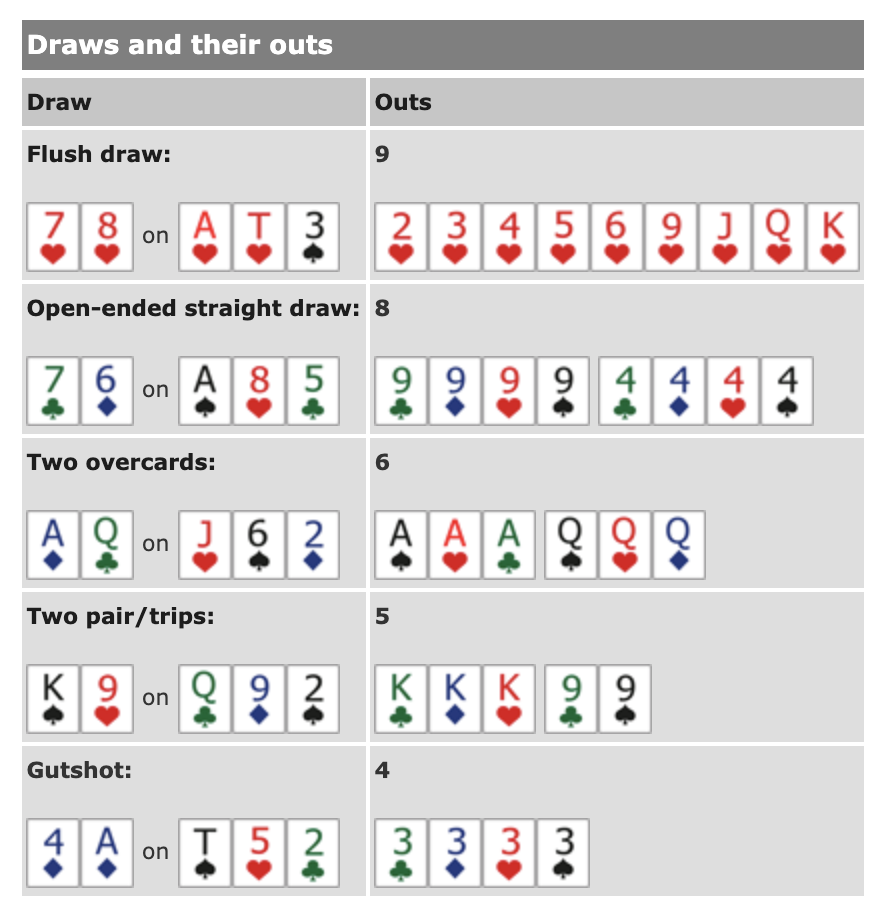
Example: You hold 87 and the flop is AT3. You have a flush draw. Every heart on the turn gives you a flush. The deck includes 13 hearts. Two of them are in your hand and two are in the flop. So there are nine hearts remaining, that can give you a flush on the turn. This means you have nine outs.
The more outs a draw has, the stronger it is. Remember only to count those cards as outs that really improve your draw into the best hand with a high probability. If an 8 appears on the turn in this example, then your hand improves into a pair, but it is anything but sure, that you will be ahead with this holding.
Texas Hold’em odds are the probability to hit an out

In order to be able to make the right decision with your draw you need to know the probability to hit an out on the turn or the river. This is calculated as follows:
Poker Counting Odds And Outs Games
Step 1: Determine the number of outs, that complete your draw.
Poker Counting Odds And Outs Printable
Step 2: Divide the number of your outs by the number of possible cards that might appear on the next street.
Poker Counting Odds And Outs Practice
Back to the example: You hold 87 and the flop is AT3 and you have a flush draw. You already know that you have nine outs by this. In the next step you have to divide the number of your outs by the total number of turn cards.
The deck has 52 cards. Five of these are already known to you. Two of them you hold in your hand and three are in the flop. So there are 47 unknown cards left that can appear on the turn. So the probability to get the flush on the turn is:
9 outs / 47 possible cards = 0,19 = 19% ~ 4 to 1.
The probability is called odds. In Texas Hold’em, odds are regularly given in the notation “x to y”. A probability of 19% means that you will hit an out on the next street in about one out of five cases. This is given by “4 to 1”. An average there are four misses opposed to one hit.
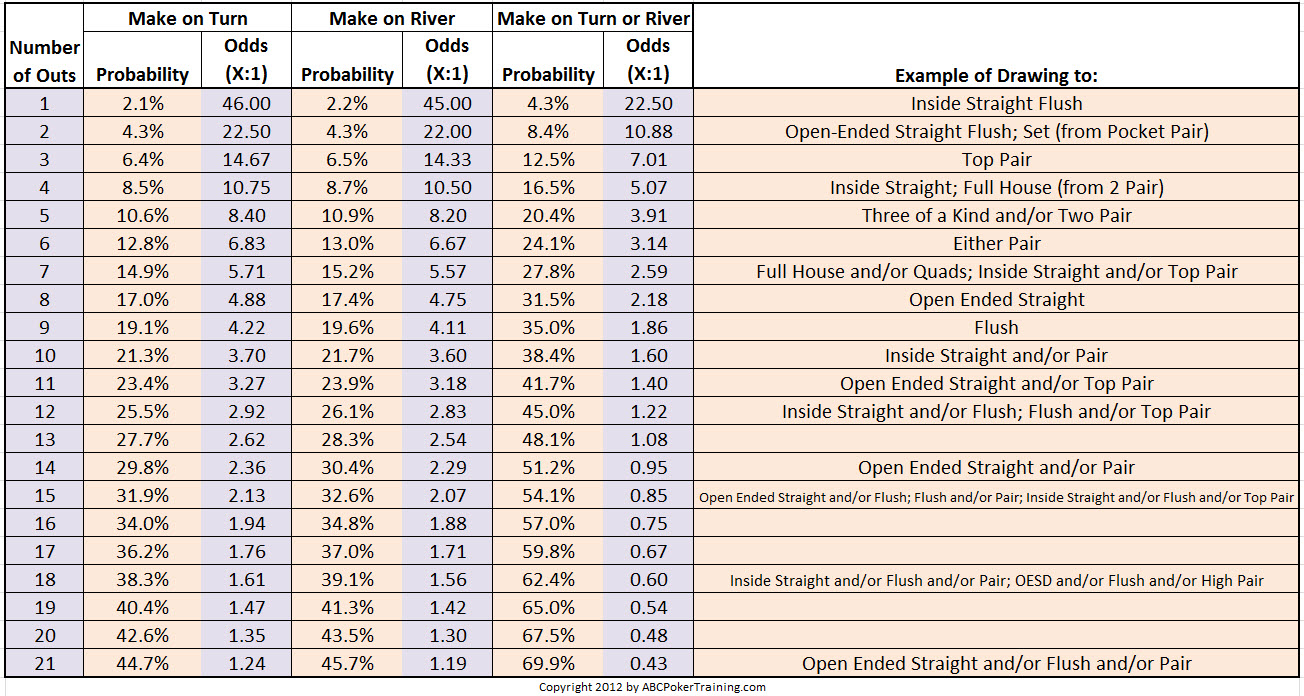
In the following chart you find pokerodds for typical situations. It also includes Texas Hold’em odds from the flop to the river. For example, these are important in an all-in situation, since in an all-in you will see the turn and river for sure.
To learn more about the basics of outs in poker check out this article or watch the video below: