Qt Call Slot Thread
- Qt Call Slot In Different Thread
- Qt Call Slot Thread Holders
- Qt Call Slot Thread Gages
- Qt Run Slot In Thread
- Qt Call Slot From Another Thread
However, the connected slot function Syncro::jumpToFrame(int newframe) does not get called. If I change the connect from QueuedConnection to DirectConnection the slot function gets called but, as expected, in the context of my serviceThread. I need the slot function to run on the main thread. Working with threads, slots and signals example (Qt 4.8) - MarinaMeyta/qthreads.
EnArBgDeElEsFaFiFrHiHuItJaKnKoMsNlPlPtRuSqThTrUkZh
This page was used to describe the new signal and slot syntax during its development. The feature is now released with Qt 5.
- Differences between String-Based and Functor-Based Connections (Official documentation)
- Introduction (Woboq blog)
- Implementation Details (Woboq blog)
Note: This is in addition to the old string-based syntax which remains valid.
- 1Connecting in Qt 5
- 2Disconnecting in Qt 5
- 4Error reporting
- 5Open questions
Qt Call Slot In Different Thread
Connecting in Qt 5
There are several ways to connect a signal in Qt 5.
Old syntax
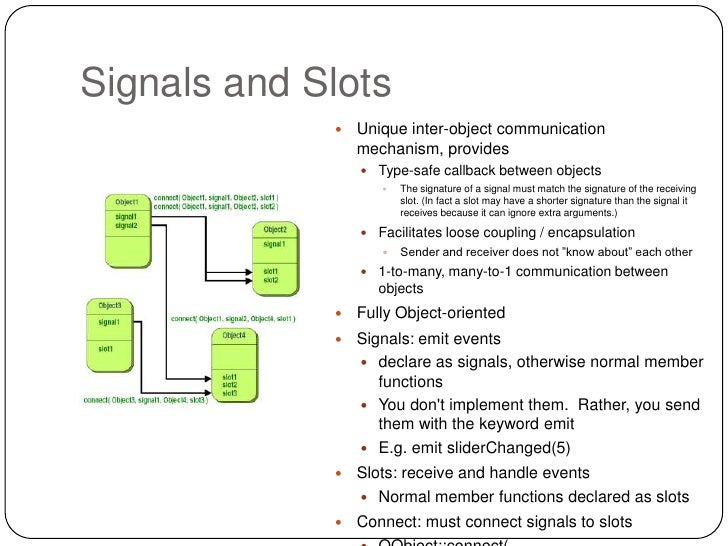
Qt 5 continues to support the old string-based syntax for connecting signals and slots defined in a QObject or any class that inherits from QObject (including QWidget)
New: connecting to QObject member
Here's Qt 5's new way to connect two QObjects and pass non-string objects:
Pros
- Compile time check of the existence of the signals and slot, of the types, or if the Q_OBJECT is missing.
- Argument can be by typedefs or with different namespace specifier, and it works.
- Possibility to automatically cast the types if there is implicit conversion (e.g. from QString to QVariant)
- It is possible to connect to any member function of QObject, not only slots.
Cons
- More complicated syntax? (you need to specify the type of your object)
- Very complicated syntax in cases of overloads? (see below)
- Default arguments in slot is not supported anymore.
New: connecting to simple function
The new syntax can even connect to functions, not just QObjects:
Pros
- Can be used with std::bind:
- Can be used with C++11 lambda expressions:
Cons
- There is no automatic disconnection when the 'receiver' is destroyed because it's a functor with no QObject. However, since 5.2 there is an overload which adds a 'context object'. When that object is destroyed, the connection is broken (the context is also used for the thread affinity: the lambda will be called in the thread of the event loop of the object used as context).
Disconnecting in Qt 5
As you might expect, there are some changes in how connections can be terminated in Qt 5, too.
Old way
You can disconnect in the old way (using SIGNAL, SLOT) but only if
- You connected using the old way, or
- If you want to disconnect all the slots from a given signal using wild card character
Symetric to the function pointer one
Only works if you connected with the symmetric call, with function pointers (Or you can also use 0 for wild card)In particular, does not work with static function, functors or lambda functions.
New way using QMetaObject::Connection
Works in all cases, including lambda functions or functors.
Asynchronous made easier
With C++11 it is possible to keep the code inline
Here's a QDialog without re-entering the eventloop, and keeping the code where it belongs:
Another example using QHttpServer : http://pastebin.com/pfbTMqUm
Error reporting
Tested with GCC.
Fortunately, IDEs like Qt Creator simplifies the function naming
Missing Q_OBJECT in class definition
Type mismatch
Open questions
Default arguments in slot
Qt Call Slot Thread Holders
If you have code like this:
The old method allows you to connect that slot to a signal that does not have arguments.But I cannot know with template code if a function has default arguments or not.So this feature is disabled.
There was an implementation that falls back to the old method if there are more arguments in the slot than in the signal.This however is quite inconsistent, since the old method does not perform type-checking or type conversion. It was removed from the patch that has been merged.
Overload
As you might see in the example above, connecting to QAbstractSocket::error is not really beautiful since error has an overload, and taking the address of an overloaded function requires explicit casting, e.g. a connection that previously was made as follows:
connect(mySpinBox, SIGNAL(valueChanged(int)), mySlider, SLOT(setValue(int));
cannot be simply converted to:
...because QSpinBox has two signals named valueChanged() with different arguments. Instead, the new code needs to be:
Unfortunately, using an explicit cast here allows several types of errors to slip past the compiler. Adding a temporary variable assignment preserves these compile-time checks:
Some macro could help (with C++11 or typeof extensions). A template based solution was introduced in Qt 5.7: qOverload
The best thing is probably to recommend not to overload signals or slots …
… but we have been adding overloads in past minor releases of Qt because taking the address of a function was not a use case we support. But now this would be impossible without breaking the source compatibility.
Disconnect
Should QMetaObject::Connection have a disconnect() function?
The other problem is that there is no automatic disconnection for some object in the closure if we use the syntax that takes a closure.One could add a list of objects in the disconnection, or a new function like QMetaObject::Connection::require
Callbacks
Function such as QHostInfo::lookupHost or QTimer::singleShot or QFileDialog::open take a QObject receiver and char* slot.This does not work for the new method.If one wants to do callback C++ way, one should use std::functionBut we cannot use STL types in our ABI, so a QFunction should be done to copy std::function.In any case, this is irrelevant for QObject connections.
Example
Some times you see a signal is emitted in sender thread but connected slot doesn't called (in other words it doesn't receive signal), you have asked about it and finaly got that the connection type Qt::DirectConnection would fix it, so the problem found and everything is ok.
But generaly this is bad idea to use Qt:DirectConnection until you really know what is this and there is no other way. Lets explain it more, Each thread created by Qt (including main thread and new threads created by QThread) have Event loop, the event loop is responsible for receiving signals and call aproporiate slots in its thread. Generaly executing a blocking operation inside an slot is bad practice, because it blocks the event loop of that threads so no other slots would be called.
If you block an event loop (by making very time consuming or blocking operation) you will not receive events on that thread until the event loop will be unblocked. If the blocking operation, blocks the event loop forever (such as busy while), the slots could never be called.
In this situation you may set the connection type in connect to Qt::DirectConnection, now the slots will be called even the event loop is blocked. so how this could make broke everything? In Qt::DirectConnection Slots will be called in emiter threads, and not receiver threads and it can broke data synchronizations and ran into other problems. So never use Qt::DirectConnection unless you know what are you doing. If your problem will be solved by using Qt::DirectConnection, you have to carefull and look at your code and finding out why your event loop is blocked. Its not a good idea to block the event loop and its not recomended in Qt.
Qt Call Slot Thread Gages
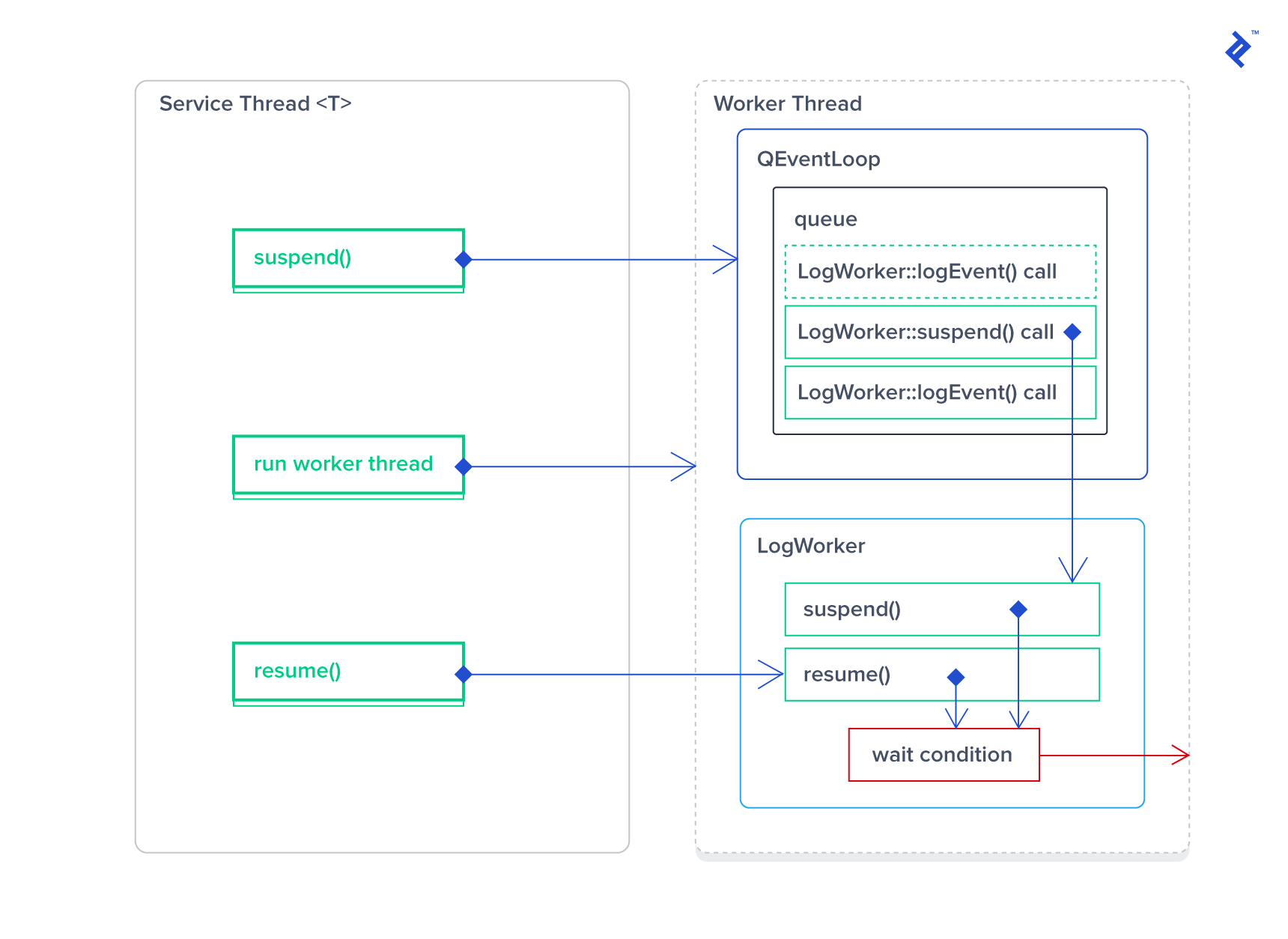
Here is small example which shows the problem, as you can see the nonBlockingSlot would be called even the blockingSlot blocked event loop with while(1) which indicates bad coding